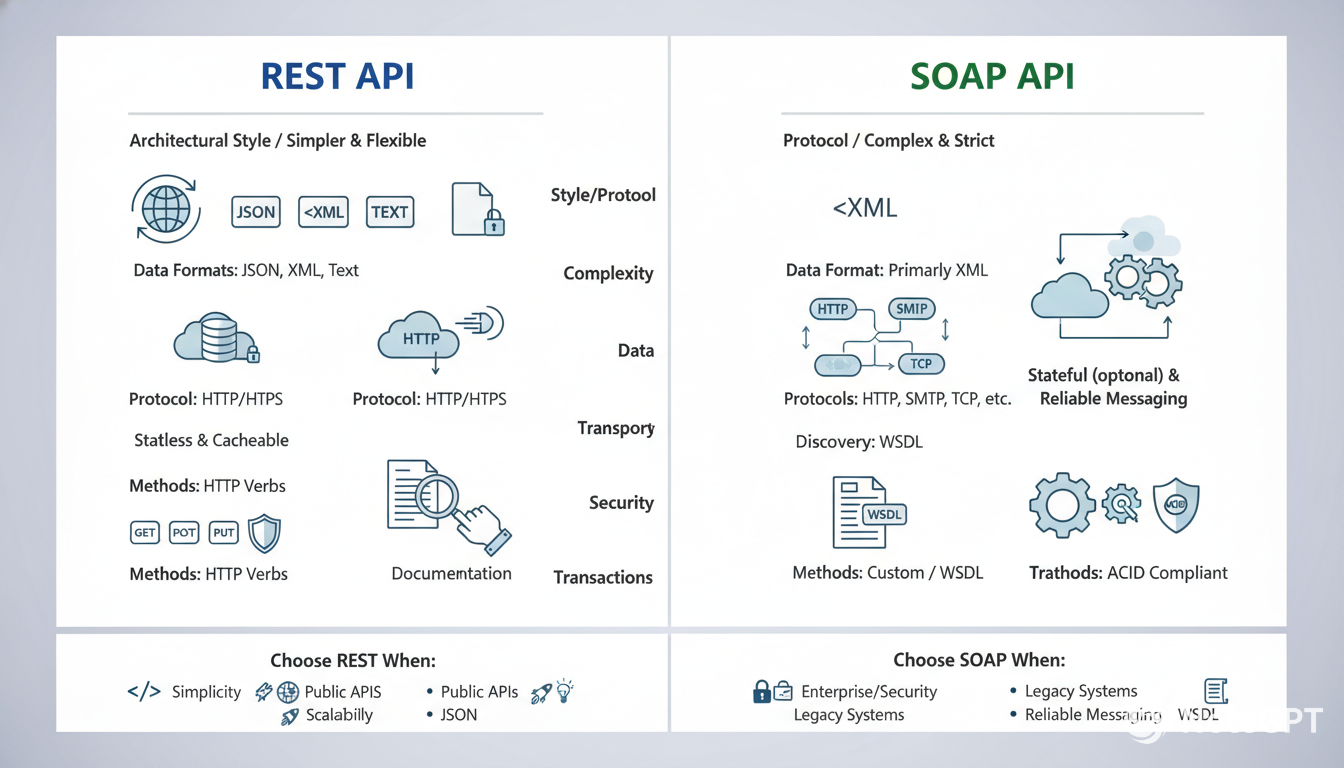
APIs allow different systems to communicate with each other. Two common API approaches are REST and SOAP. While both serve the same purpose, they work very differently and suit different business needs.
What Is a REST API?
REST (Representational State Transfer) is a lightweight and flexible API architecture commonly used in modern web applications.
Key Features:
- Uses standard HTTP methods (GET, POST, PUT, DELETE)
- Supports multiple data formats (JSON, XML)
- Faster and easier to use
- Widely used in web and mobile applications
Best For:
- Web and mobile apps
- Public APIs
- Fast, scalable systems
What Is a SOAP API?
SOAP (Simple Object Access Protocol) is a strict, XML-based messaging protocol often used in enterprise systems.
Key Features:
- Uses XML only
- Strong security and transaction support
- Built-in error handling
- Requires strict standards and contracts (WSDL)
Best For:
- Banking and financial systems
- Enterprise-level applications
- Complex, secure transactions
Which One Should You Choose?
-
Choose REST API if you want speed, flexibility, and scalability.
-
Choose SOAP API if your project demands strict security and complex transactions.
Conclusion
Both REST and SOAP APIs have their strengths. The right choice depends on your project requirements, security needs, and long-term scalability goals.